
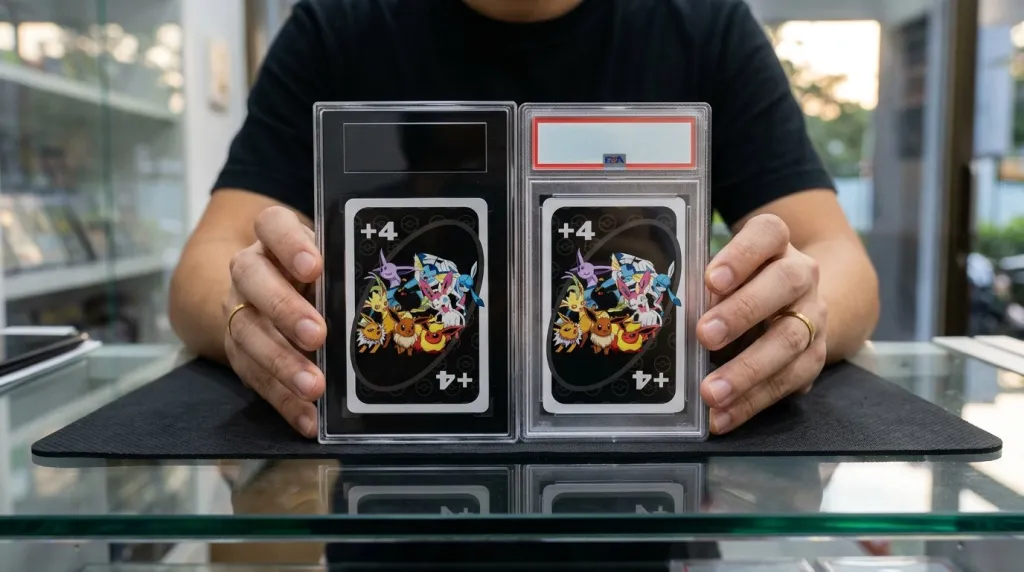
A BGS Black Label usually sells for more than a PSA 10 of the same card, but the premium depends on rarity and actual sales of matching copies; in a BGS Black Label vs. PSA 10 value comparison, the label alone doesn’t set a fair value. Collectors prize the Black Label’s perfect subgrades, while PSA 10 slabs can be easier to trade because more buyers recognise and pursue them. A BGS 9.5 adds another comparison point, but it isn’t interchangeable with either grade. This guide explains how grading standards, scarcity, resale demand and same-card sale records shape the value gap, and how to weigh the trade-offs when buying, selling or deciding which slab better fits your collection in Singapore.
Key Takeaways
- A Black Label requires perfect 10 subgrades, so its scarcity comes from a stricter standard than the grade number alone suggests.
- PSA 10 slabs may be easier to trade, while a Black Label’s premium depends on how much buyers value that card’s rarity.
- When weighing BGS 9.5 against PSA 10, compare the card’s condition and grading criteria rather than treating the grades as equivalent.
- For a useful value check, compare recent sales of the exact card in each grade and account for differences in sale timing and demand.
BGS Black Label rarity and premiums
Which card categories have the largest BGS Black Label premium over PSA 10? No category-wide ranking applies, but ultra-premium Pokémon cards can attract strong collector interest. Charizard cards are examples: a Black Label Charizard may command a larger premium than its PSA 10 counterpart, and collectors have reported especially high premiums for the Mega Charizard Poncho Pikachu.
Can a PSA 10 card qualify for a BGS Black Label, and what are the grading standards? Yes, the card can be submitted to Beckett for grading, but PSA 10 does not guarantee a Black Label. Beckett requires perfect 10 subgrades for centering, corners, edges and surface; a BGS 10 without four perfect subgrades receives the standard Pristine Gold Label.
That threshold helps explain the label’s scarcity: fewer than 1 percent of cards graded by Beckett earn a Black Label. For collectors, the premium reflects both the card’s condition and how strongly buyers value that rare distinction. Some collector reports put Black Label sales at 1.5 to 5 times the same card’s PSA 10 value, but the gap varies by card and demand.
How do card population reports affect BGS Black Label versus PSA 10 value? They show how many copies each grader has assigned a grade, helping you judge relative scarcity. A low Black Label count can strengthen its scarcity appeal, while a higher PSA 10 count can indicate broader availability. Counts alone don’t establish demand or determine a sale value.
| Grade option | Standard | Collector signal |
|---|---|---|
| PSA 10 | Gem Mint grade | Widely recognised top grade |
| BGS 10 Gold Label | At least three 10 subgrades and one 9.5 | Pristine, but not Black Label |
| BGS 10 Black Label | Four perfect 10 subgrades | Rarer premium grade |
Compare the specific card’s grading standard, population counts, and buyer demand, rather than relying on the label alone.
Buyer recognition and market liquidity
PSA 10 often has broad buyer recognition, while BGS Black Label can attract collectors seeking a specific top-grade slab. Which label suits your collecting interests depends on the card and the buyers pursuing it.
Market Recognition
PSA 10 is a familiar reference point for collectors comparing graded cards. BGS Black Label’s appeal centres on its perfect subgrades, which can matter more to buyers focused on detailed condition assessments. For modern cards, BGS 10 Gold Label can also attract strong demand. These differences mean that buyer preferences, not just the grading company, shape how each label is received.
Buyer Interest
Liquidity describes how readily a card finds a buyer. A PSA 10 may appeal to a wider range of collectors, while a BGS Black Label may draw buyers specifically seeking that distinction. Grading, crossover and resubmission can change the outcome by producing a different grade. Consider the current slab’s buyer appeal and the possible result of another grading submission before choosing a path.
Factors Affecting Buyer Interest
What factors affect buyer interest in BGS Black Label and PSA 10 cards? Buyer demand can shift, and a smaller audience for a specific label may make a sale harder to arrange. PSA 10’s wider recognition doesn’t remove card-specific demand changes. A single transaction also may not reflect the level of interest from other buyers.
Population reports may change as more copies are graded, which can affect how collectors view scarcity. Treat the figures as context, not as proof of future demand. Compare population reports for the same card and label, and check whether they indicate a consistent level of collector interest or an unusual result.
BGS 9.5 versus PSA 10
A BGS 9.5 and PSA 10 are both high grades, but they use different grading scales and standards. For the same card, the grade label alone doesn’t tell you whether the condition or resale appeal is equivalent.
Beckett grades from 1 to 10 in half-point steps, while PSA uses half grades from 1.5 to 8.5 and whole-number grades through 10. A BGS 9.5 is therefore not simply another name for PSA 10. PSA describes Gem Mint 10 as a pristine card, while Beckett’s 9.5 grade reflects its own assessment and subgrade system.
Centering shows why comparisons need care. PSA 10 centering is described as roughly 55/45 or better on the front and 75/25 or better on the back. A third-party source puts Beckett 9.5 centering tolerance at 60/40. These figures address centering only; they don’t establish identical standards for corners, edges or surface.
Crossover results offer one practical reference. A third-party tracker recorded 1,247 BGS 9.5 crossover attempts between 2024 and 2026, with about 40 percent receiving PSA 10. That result shows some BGS 9.5 cards can earn PSA’s top grade, but it doesn’t make the grades interchangeable. The submitted card’s centering and other condition details matter.
If you’re comparing slabs, inspect the card and its Beckett subgrades, then compare completed sales for that exact card in both grades. Consider any grading or resubmission expense before deciding whether a crossover could improve the outcome. A PSA 10 may sell for two to five times the same card’s BGS 9.5 in some comparisons, but the gap depends on the card and buyer demand.
Comparing sales for the same card
Compare the exact card, not just the same character or set. A first-edition Base Set Charizard and a later Charizard release have different buyer pools, even with matching PSA 10 labels. Match the card number, edition, language, grade and label before comparing them. A comparison of BGS Black Label and PSA 10 cards is useful only when the underlying card matches.
Sale context adds detail. At Heritage Auctions on December 12 and 13, 2025, a PSA 10 first-edition Base Set Charizard sold; 125 copies were certified at that grade. That population detail helps show why one auction result cannot represent every Charizard or PSA 10. Keep the specific printing and grade in view when reviewing the sale.
Use a consistent process. Separate completed transactions from active listings, since an active listing does not confirm a completed sale. Compare the same card in PSA 10, BGS Black Label and, where relevant, BGS 9.5. Note each sale’s venue and timing, as these affect which collectors may have seen the listing.
- Match identity: Compare the exact set, card number, edition and language.
- Match grade: Keep PSA 10 sales separate from BGS Black Label and BGS 9.5 results.
- Compare records: Review multiple completed sales rather than relying on one auction.
- Note context: Record the sale date and venue, such as Heritage Auctions in 2025.
For scarce cards, comparable sales may be limited. Treat a reported difference between Black Label and other grades as context, not a standard measure for every card. Focus on the closest available sales for the same card, along with how many comparable copies sold and how recent those transactions were.
This approach keeps your comparison focused on the card’s identity, grade and sale context. It also prevents a headline sale for one Charizard from becoming the benchmark for a different release or grade.
How to assess a graded card
Start with the card itself. Match its name, set, card number, edition and language, then compare the same printing across PSA 10, BGS 9.5 and BGS Black Label examples. A Charizard from one release isn’t a direct comparison for another. This first check keeps differences in card identity from distorting the grade comparison.
Next, separate the slab’s grade from the card’s visible condition. Beckett’s subgrades cover centering, corners, edges and surface, so review each score on a BGS 9.5. PSA 10 uses a different grading standard. A top grade from one company doesn’t automatically equal the same assessment from another.
- Confirm the match: Compare the exact set, card number, edition and language.
- Read the label: Distinguish BGS 9.5, BGS 10 Gold Label, BGS Black Label and PSA 10.
- Assess the evidence: For Beckett slabs, weigh all four subgrades rather than focusing only on the overall grade.
- Compare grading evidence: Check the same card and grade, and note the source and date of each example.
Then decide what matters most to you. If a grading standard you recognise is a priority, PSA 10 may suit your preferences. If the card has four perfect Beckett subgrades and you value that distinction, Black Label may be more appealing. For a BGS 9.5, judge its subgrades and condition evidence rather than assuming it matches PSA 10.
Decision guide: Choose PSA 10 when you prefer its grading standard. Consider BGS Black Label when its perfect subgrades matter to you. Treat BGS 9.5 as a separate grade, and compare its condition evidence directly. For any slab, let the grading evidence and your collecting priorities guide the choice, not the label alone.
Make your next card decision with confidence
Before buying or selling, decide what matters most for this specific card: collector appeal, condition or the grade itself. When comparing a BGS Black Label with a PSA 10, consider the card’s condition and how each grade fits your collection. The right choice can differ between two cards, even when both carry familiar top-grade labels.
If you’re looking for your next collectible, Gaming Otaku’s team brings collector-focused knowledge to trading card sourcing and card selection. Its range includes Pokémon and One Piece cards, alongside sealed collectibles such as the Pokémon 30th Celebration Mewtwo (What’s Your Favorite?) Stamp Promo Card. That’s a practical next step if you want to build your collection while keeping authenticity and condition in view.
Share what you collect and what you’re hoping to find. Contact Gaming Otaku for card advice, and take your next collecting decision forward with a clearer plan.
Frequently asked questions
Does BGS sell for more than PSA?
Sometimes, for a particular card and grade. Before treating a BGS result as evidence of a general premium, compare several completed sales and note whether they reflect similar selling conditions. A one-off result may reflect one buyer’s specific interest. When tracking a card over time, keep its sales record separate from those of other cards featuring the same artist or character.
Is a BGS 9.5 the same as a PSA 10?
No. Treat them as separate grading outcomes, not interchangeable labels or automatic steps in an upgrade path. If you’re choosing between copies, read each slab’s label as issued and compare the card’s sales history at each grade. In a collection inventory, record the grading company alongside the exact grade to avoid mixing different slabs in later searches or valuation notes.
Which is Worth More?
There isn’t one answer that applies to every card. A specific Black Label may attract more interest, while another card’s PSA 10 records may provide a clearer benchmark. Start with the exact card and your goal: collecting, trading or selling. Then use completed transactions to judge what buyers have actually accepted, rather than relying on a general rule about grading companies.
Which is better for resale, PSA or BGS?
Choose based on the buyers you expect for that card. To make a listing clearer, state the grading company and grade precisely, and include clear images of the card and slab label. Also specify the card’s edition and language. These details help collectors assess the item without guessing which version or grade you’re offering.
What is the difference between a BGS Black Label and a PSA 10?
They are distinct grading outcomes from Beckett and PSA, so identify the labels clearly in listings and collection records. Don’t shorten a specific slab’s grade to “gem” or “ten,” as that can obscure which grading company assigned it. When comparing listings, use the full label wording to keep your notes and sales references accurate.
How rare are BGS Black Labels compared with PSA 10s?
Black Labels are uncommon, but a useful comparison depends on the specific card. Check each grader’s population for that card and record when you viewed the figures. A report is a snapshot, not a forecast of future buyer interest. For a scarce release with few comparable sales, use population information as context, not as a guarantee of resale value.