
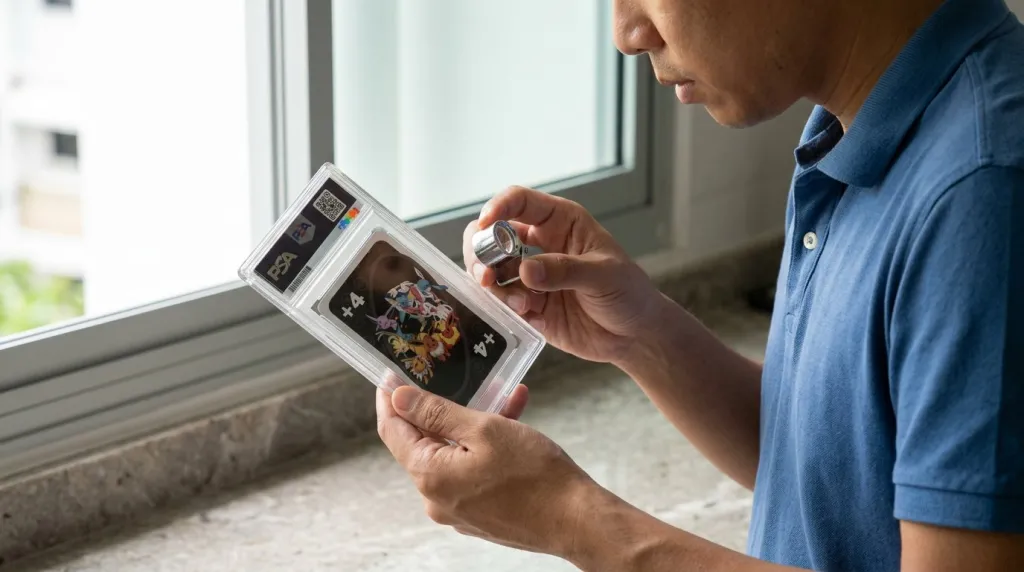
To learn how to spot counterfeit PSA slabs, assess the scan, slab details and seller media together. No single clue proves whether a slab is genuine.
A certification lookup can support your assessment, but it cannot prove that the pictured holder contains the card shown in the record.
This guide helps you evaluate listing photos and videos, spot mismatches, and make a more informed decision before buying a graded card in Singapore.
Key Takeaways
- Scan the barcode and QR code, but compare the returned card details with the slab itself; copied codes can point to genuine records.
- Look for sharp, consistent label lettering and straight, rectangular insert edges, then consider any mismatch alongside other signs.
- Treat a matching certification number as one check, not proof. A genuine number can be copied onto a counterfeit slab.
- Ask for clear photos or video of the holder from multiple angles, including its edges and security features, before deciding whether to proceed.
Barcode and QR code scans
- Scan both codes on the PSA label, then compare the certification details with the card inside the holder. A barcode or QR code can retrieve the slab’s record, but a successful scan does not authenticate the plastic or the card. Counterfeiters may copy genuine codes, so a fake slab can return details for a real card. Treat a match as one check, not a final verdict.
- Check the label’s other security details in clear photos or video. Genuine PSA slabs have barcode and QR codes, plus silver PSA logos with an illumination effect on the front and back labels. PSA began adding UV marks around 2012. The back label has six UV PSA logos around its large silver PSA logo, and both labels have a subtle bluish fugitive-ink PSA graphic in their white areas.
- Use more than a screen scan to judge how to spot counterfeit PSA slabs. PSA has used tamper-evident holders since 1991, sealed with a sonic weld. That seal is tamper-evident, not tamper-proof. If a holder has been opened, its firmness may differ; breaking the weld can leave cloudiness or frosting along the edges, or visible cracks. A copied code cannot explain away those physical signs.
- If a scan and the physical slab do not agree, pause the purchase. Ask for clear images of both labels and the holder, then request an authenticity check from PSA through its support page. You can also take time to discuss the item with a trusted collector or adviser. If you proceed, make the purchase contingent on PSA confirming authenticity.
- Counterfeit slabs are a risk, but a code scan alone cannot show how often they appear. The financial risk is paying for a card or holder that is not genuine, then having difficulty recovering your payment. A credit-card purchase may allow you to dispute the charge if the slab or card turns out to be fake. Keep the listing and seller messages with your purchase records.
Card insert edges and label font
- Inspect the plastic around the card insert in a close, straight-on image. PSA’s plastic edges around the card should look sharp and rectangular, even when the card itself has rounded corners. Compare the shape on every side. Uneven, soft-looking or irregular edges deserve a closer look, but one unclear photo cannot establish whether a slab is counterfeit.
- Read the label lettering closely rather than judging it from a distance. PSA slab labels use black, sans-serif, uppercase text with sharp edges and consistent sizing. Look for letters that appear blurred, unevenly spaced, unusually thin or inconsistent on the same label. Ask for a sharper image if compression or glare makes the text difficult to assess.
- Check whether the label looks unusually thick or obscured. PSA enhanced product security in 2017, with a focus on the label inside the holder. An added paper layer can make a label too thick to see through and may cover parts of the authentic label beneath. Hold the slab up to light at close range: text on the opposite side should be visible.
- Inspect the holder seams and edges for signs of opening. PSA holders are tamper-evident, not tamper-proof. Breaking the sonic weld can leave frosting or cloudiness along the edges, or visible cracks. These marks can indicate interference, but assess them alongside the label and insert instead of treating any one mark as proof.
- Compare the full label and holder, not just one security detail. A genuine barcode or hologram detail can be copied, so it cannot resolve concerns about poor lettering or a covered label. Request close views of the insert edges, label and seams from multiple angles. If the photos do not show these features clearly, pause before buying and ask for better images.
Certification number verification
- Find the certification number on the slab label, then enter it into PSA’s certification lookup. Read the returned record carefully. Check that the card identity and grade match the item shown in the holder. A plausible result is useful evidence, but it does not authenticate the physical slab.
- Compare the record with the card, not just the seller’s title. For example, if the listing describes a different card from the PSA record, stop and ask for an explanation. Confirm that the pictured card, label details and online result all refer to the same collectible. Small differences matter when the number belongs to another item.
- Remember that counterfeiters can copy a genuine certification number. A fake slab may return details for a real card, even when its contents do not match. That is why a lookup cannot replace close inspection of the card and holder. Treat a number match as one part of your assessment, not proof.
- Check whether the seller’s photos clearly show the actual slab. Match the printed number and card details to the record, then look for consistency across the front and back images. If the number is cropped, blurred or hidden by glare, request a clearer view. A screenshot of a lookup alone does not show that the pictured slab holds that card.
- If doubts remain, request an authenticity check from PSA through its support page. Include the certification details and clear images of the slab, card and labels. Pause the transaction while you resolve any mismatches. For a high-value collectible, you can make the purchase contingent on PSA confirming authenticity. Keep the listing and seller messages as a record of the item and the seller’s claims.
A returned record identifies what is associated with the certification number; it does not, by itself, establish that the slab in front of you is genuine. A counterfeit PSA slab can use a genuine certification number, so checking the number alone may return details for a real card. Keep this distinction in mind whenever the physical holder remains uncertain.
If the card and record appear consistent but you are still unsure about the slab, ask PSA to check its authenticity through its support page. This is a way to seek clarification when the lookup cannot establish whether the holder itself is genuine.
Checking seller photos and videos
- Start with the listing’s original photos, not cropped screenshots. Check that the front, back, label and holder edges are visible. Look for consistent lighting and focus across the images. If glare hides a label detail, ask for another angle rather than guessing from the obscured view.
- Ask for a short video showing the slab turning from front to back. PSA slabs have silver logos with an illumination effect on both labels and raised PSA logos in the plastic’s bottom-right corners. A moving view can reveal details that a single still image hides. Compare the visible features in the video with those in the listing photos.
- Check whether the media shows the actual slab being offered. Request a fresh image with the card and label together if the photos look generic or inconsistent. Watch for abrupt changes between shots, missing views of the holder or details concealed by glare. These signs do not prove fraud, but they leave important questions unanswered.
- To compare the card with its certification photos, line up the artwork, name, layout and visible condition. Check that the slab in the seller’s images matches the card shown in the PSA record. A genuine record can still be copied onto another slab, so matching details across the card, label and photos matters.
- For a safer purchase in Singapore, favour sellers with a clear track record and references. PSA advises caution with unsolicited offers from unfamiliar people or companies, especially deals that seem too good to be true. If you have doubts, wait a day or two and consult a trusted collector. Paying by credit card may allow you to dispute the charge if the slab or card turns out to be fake.
For online purchases, compare the seller’s slab photos with photos of genuine slabs, focusing on visible security features rather than relying on the seller’s description. Ask for a video that shows those features clearly, then compare it with the still images. This gives you another view of the same slab and helps you assess whether the images are consistent.
Gaming Otaku
Gaming Otaku offers trading card sourcing and consignment for collectors building or managing a collection. These services can be a practical next step after reviewing a slab’s photos, scans and certification details, but they do not replace PSA’s authenticity check.
If you’re considering a graded card, use the checks in this guide to assess the listing and slab before deciding. Trading card sourcing can help you search for a card you want; consignment is an option when you’re ready to sell cards from your collection.
Contact Gaming Otaku to discuss trading card sourcing or consignment.
Make your next collecting move with care
Knowing how to spot counterfeit PSA slabs gives you a better basis for deciding what to buy, but careful buying is only one part of collecting. Think about what you want to add next, then pay the same attention to item details and condition when comparing options.
Gaming Otaku offers collectibles including the Pokémon 30th Celebration Mewtwo (What’s Your Favorite?) Stamp Promo Card (Sealed), the ONE PIECE Card Game 4th Anniversary Four Emperors Treasure Get Campaign Pack (JP), and the Kayou Sanrio Characters Cute Dream Fun Pack Booster Box (30 Packs). These examples span different corners of the hobby, so you can keep exploring without losing sight of what matters to your collection.
For a next step, contact Gaming Otaku about your collecting plans. Take your time, make choices that fit your collection, and enjoy the hunt.
Frequently Asked Questions
Where is the PSA certification number on a slab and what should it match?
The certification number appears on the PSA label inside the slab. Match it with the card details in PSA’s lookup, then check that those details fit the card pictured in the holder. For example, a matching grade does not resolve a different card name or image. If the number is difficult to read in a seller’s listing, request a clear label photo before deciding.