
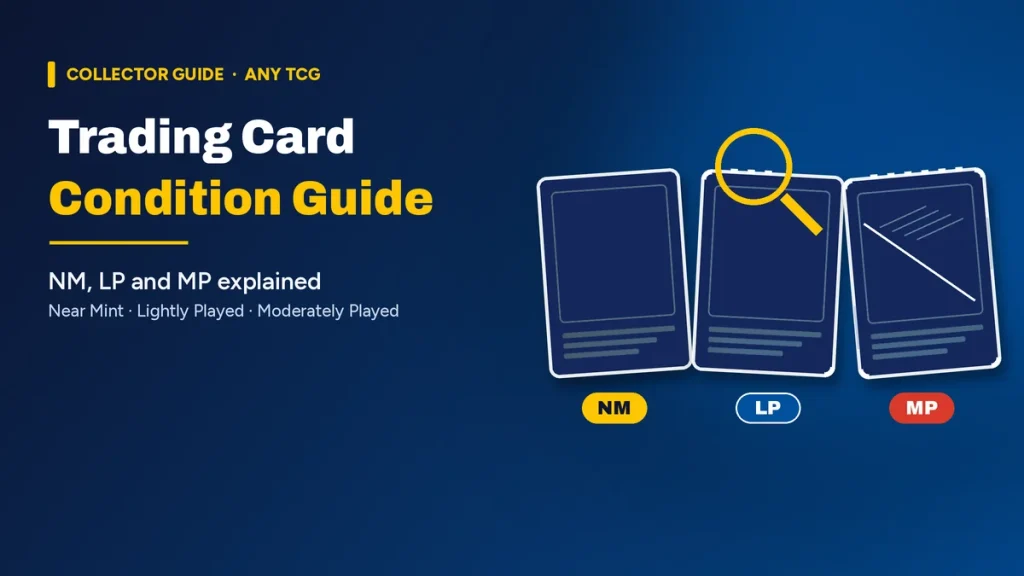
NM (Near Mint) means a card with minimal wear that still looks nearly unplayed, LP (Lightly Played) means minor wear such as light edge wear or scuffs with nothing structural, and MP (Moderately Played) means clear wear that can include minor bends, as long as the card is still sound. These are seller and marketplace conventions, not one official standard: TCGplayer’s own Card Conditioning Standards say a clear and universal guide for conditions doesn’t exist in the hobby.
The same letters turn up on singles for Pokémon, the One Piece Card Game, Disney Lorcana, Magic: The Gathering, Yu-Gi-Oh! and sports cards such as Topps Chrome. Here is how the two big marketplace scales work, why NM is not a PSA grade, and what to check on any card before you pay.
Is there an official card condition standard?
No. Each marketplace or shop writes its own scale. TCGplayer built its standards because, in its words, a universal guide doesn’t exist, and it points to “a lack of clear criteria for different conditions” in both gaming and sports cards. Cardmarket says on its card condition page that grading “is not an exact science” and that one person’s Near Mint can be another’s Excellent.
TCGplayer also draws a useful line: it calls a word label like NM or LP “conditioning” and keeps “grading” for numerical scores, usually from professional grading services.
NM, LP and MP at a glance
TCGplayer’s standards are a detailed, published example. Every flaw gets a severity, Slight (1 point), Minor (2), Moderate (4) or Major (8), and each condition has a points budget:
| Condition | How TCGplayer describes it | Points allowed | Not allowed |
|---|---|---|---|
| Near Mint (NM) | Minimal handling or play wear | Up to 3 | Surface wear, grime, bends, faults, damage |
| Lightly Played (LP) | Signs of handling or play, but no significant imperfections | Up to 6 | Faults, damage |
| Moderately Played (MP) | Significant play, use or wear | Up to 12 | Damage |
Below MP sit Heavily Played (up to 24 points) and Damaged. TCGplayer’s Card Conditioning Overview adds that Mint and Gem Mint cards are not sold on its marketplace, so NM is the top raw condition there.
Near Mint (NM)
Slight edge wear, slight scuffing or a couple of minor scratches are fine, but the card should look nearly unplayed. Any bend takes it out of NM.
Lightly Played (LP)
Noticeable minor edge wear, scuffs or scratches, with nothing that affects the card’s structure. A minor bend or slight surface wear can still fit.
Moderately Played (MP)
Edge wear, surface wear, scratching and bends with creases, alone or together, as long as the structure holds. Tears, splitting, folds or foreign substances make a card Damaged.
Cardmarket uses a different ladder
Cardmarket’s scale has seven steps: Mint, Near Mint, Excellent, Good, Light Played, Played and Poor. Its Light Played is the fifth step, below Excellent and Good, while TCGplayer’s Lightly Played sits directly below Near Mint. Same letters, different rung, so check which scale a seller is using.
Cardmarket is strict at the top. Its Seller Guide says a card is only Near Mint if the front and back are both Near Mint, that sellers shouldn’t call a card Near Mint unless it looks brand new, and “when in doubt, use a lower grading”. It also says visible clouding rules out Near Mint, surface scratches make a card Good at best, and foil surfaces are much more sensitive to scratches.
Near Mint is not a PSA grade
A card that hasn’t been graded and slabbed by a service like PSA or BGS is a raw card, as Topps puts it. NM, LP and MP describe raw cards. A grading service instead assigns a numerical grade from 1 to 10, higher meaning better.
PSA’s labels pair words with numbers, such as PSA NM 7 and PSA NM-MT 8, which is where the confusion starts. Its grading standards describe a Gem Mint 10 as a virtually perfect card with four perfectly sharp corners, full original gloss and centring within about 55/45 on the front and 75/25 on the back. TCGplayer, by contrast, lets a raw card sit up to 70/30 off-centre with no effect on its condition.
So there is no fixed conversion between a seller’s NM and a PSA number, and PSA says part of grading is a judgement call on eye appeal. Treat “NM” as the seller’s description and a PSA number as PSA’s result for that one card.
How to check card condition, in any game
The checks are the same for a Pokémon holo, a One Piece Card Game parallel art, a Disney Lorcana foil, a Magic foil or a Topps Chrome refractor:
- Tilt it under a light. Scratches, scuffs and clouding often only show at an angle.
- Check all four corners. Topps describes a dinged corner as bent, blunted or otherwise damaged, usually from mishandling, sometimes from cards shifting in the pack.
- Look at the back too. Cardmarket only calls a card Near Mint if the front and back both qualify.
- Lay it flat. TCGplayer allows up to 5mm of curl before a card counts as Damaged, and says foil cards, in particular Magic: The Gathering cards, may be more prone to curling.
- Watch for alterations. TCGplayer treats stamps, signatures, paint or marker as Damaged; Cardmarket treats inked or whitened borders as Poor.
Shiny finishes need extra care: our Topps Chrome beginner’s guide explains the reflective chromium card stock. When judging from photos, ask for sharp shots of the front and back, plus one tilted under light.
FAQs
What does NM mean on a trading card?
NM stands for Near Mint. It describes a raw card with minimal wear that still looks nearly unplayed. On TCGplayer’s scale an NM card can have slight edge wear, slight scuffing or a couple of minor scratches, but no bends, surface wear or damage. Cardmarket words it differently: its seller guide says a card should look brand new before it is called Near Mint.
What is the difference between LP and MP?
On TCGplayer’s scale, Lightly Played (LP) cards show signs of handling or play but no significant imperfections, with up to 6 points of flaws allowed. Moderately Played (MP) cards show significant play or wear, can include minor bends with creases, and allow up to 12 points. Neither allows damage that affects the card’s structure, such as tears or splitting.
Is Near Mint the same as PSA 8?
No. There is no fixed conversion between a seller’s Near Mint and a PSA number. NM is a word label for raw cards, while PSA assigns its own graded number from 1 to 10 after its own inspection. PSA also uses its own word labels, such as PSA NM 7 and PSA NM-MT 8, so the same letters do not mean the same thing.
Is there one official condition standard for Pokémon, One Piece and Yu-Gi-Oh!?
No. There is no single official NM, LP and MP standard for any of these games, so each marketplace or shop sets its own. TCGplayer says a clear and universal condition guide doesn’t exist in the hobby, which is why it wrote its own. Cardmarket uses a different seven-step scale where Light Played sits below Excellent and Good, so always check which scale a seller follows.
How do I check card condition from photos?
Ask the seller for clear, sharp photos of both the front and the back, plus one tilted under a light to show scratches or clouding. Then check all four corners for dings or whitening, the edges for wear, and the surface for scuffs. Cardmarket says a card is only Near Mint if the front and back are both Near Mint.