
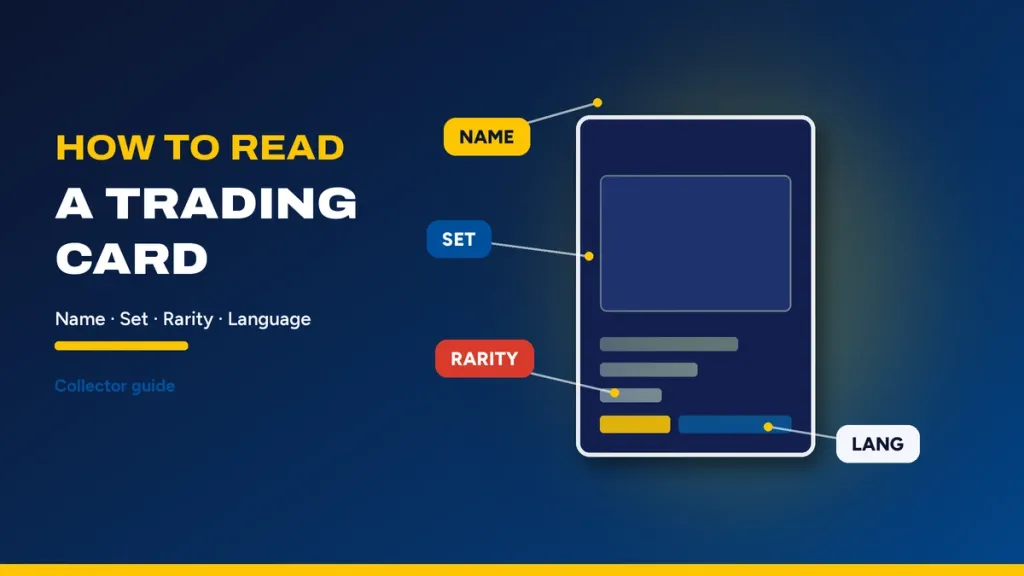
Reading a trading card means finding four things on the face: the card name, the set or expansion identity, the collector or card number, and the rarity mark, plus any language code the publisher prints. Each game places these differently, so read Pokémon, Yu-Gi-Oh!, One Piece Card Game, Magic: The Gathering and Disney Lorcana from that company’s own rulebook or glossary. Singapore collectors often compare Japanese, Asian-English and English printings; this guide shows what each official document labels, then points to our Japanese vs English editions guide.
Start with the card name
Start at the name line. The Pokémon Trading Card Game rulebook (last updated September 2026) labels CARD NAME among the parts of a Pokémon card. Bandai’s One Piece Card Game Comprehensive Rules (updated 28 August 2026) and the Official Rule Manual both treat Card Name as fixed card information.
Disney Lorcana splits identity into two lines. The Comprehensive Rules (updated 25 November 2025) say the name appears in larger print, a version differentiates cards that share a name, and the name and version together are the full name. On Magic: The Gathering cards, Comprehensive Rules 201.1 place the name in the upper left corner, and 201.2 say that for game purposes the name is always the English version, even when the printed language differs.
Set codes, expansion codes and collector numbers
After the name, match the card to one printing in one set.
| Game | Official label | What to look for |
|---|---|---|
| Pokémon TCG | Expansion code; collector card number | Rulebook “Parts of a Pokémon Card” labels |
| One Piece Card Game | Card number; block symbol | Card number for deck limits; block number, lower right |
| Magic: The Gathering | Collector number; set code; language code | Small print under the text box |
| Disney Lorcana | Collector number; set number; language | Ancillary line: number/total, set index, language |
The Pokémon rulebook labels EXPANSION CODE and COLLECTOR CARD NUMBER. Pokémon.com’s Scarlet & Violet aesthetic article (30 March 2023) adds that on parallel foil cards in that series, the expansion-code box that is normally black with white text becomes a white box with black text.
For One Piece, Comprehensive Rules 2-14 say the card number is referenced during game preparation and that a deck may contain no more than four cards with the same card number. The Rule Manual also labels Card Number, Rarity and Block Symbol. Bandai’s Block Number System topic (23 July 2025) explains that Block Numbers are printed in the lower right corner and, from 1 April 2026, help designate championship card pools.
Magic’s rule 213 covers the line under the text box. Collector numbers appear as `[card number]/[total]` or simply `[card number]`. The same line carries a three-character set code and a two-character language code, separated by a bullet on a regular card or by a star on a premium card.
Lorcana’s ancillary line (rule 6.2.14) lists a collector number (unique standard cards after the slash), a set number (The First Chapter as 1 through Ursula’s Return as 4) and a language field. Ancillary information is not used for gameplay.
How each game marks rarity
Rarity is where games diverge most.
Pokémon TCG (Scarlet & Violet Series onward). Pokémon.com lists a solid black circle, diamond and star for common, uncommon and rare; two solid black stars for double rare; two shiny foil stars for ultra rare; one shiny gold star for illustration rare; a special illustration rare tier for alternate-art Pokémon ex and some Supporters; and three shiny gold stars for hyper rare cards, previously called secret rare. Use that official page as the glossary for those symbols.
Yu-Gi-Oh! TCG. Konami describes rarity by foil in its Glossary of Yu-Gi-Oh Terms and New to Yu-Gi-Oh! page. Common cards have no foil. Rare cards have an embossed silver foil name. Super Rare cards have holographic art with no foil name. Ultra Rare cards add a gold or colourful foil name to holographic art. Secret Rare cards use a rainbow foil name and a sparkling holographic finish. The New to page also notes a numerical password on the bottom left of many cards and a security foil on the bottom right that is gold on First Edition or Limited Edition printings and silver on Unlimited Edition.
One Piece Card Game. Comprehensive Rules 2-13 state that rarity specifies the card’s rarity and does not affect gameplay.
Magic: The Gathering. Rule 213.1b says rarity is indicated with a single letter following the collector number. The rules text we checked does not expand those letters into words, so we will not invent a table.
Disney Lorcana. The rarity symbol “indicates how common the card is among the cards in the set it was printed in.” The Quick Start rarity key names Common, Uncommon, Rare, Super Rare, Legendary and Enchanted.
Language cues, then a short checklist
Magic prints a two-character language code beside the set code. Lorcana lists Language in the ancillary line and states that English cards, rules, rulings and clarifications are the official versions for gameplay. Edition choice in Singapore is covered in our Japanese vs English trading cards guide.
Before you trade or list a single: (1) read the name (and Lorcana version, if present); (2) note the set or expansion identity and collector or card number; (3) check that game’s rarity treatment; (4) note any language cue; (5) judge condition with our trading card condition guide.
FAQs
Where is the set code on a Pokémon card?
The Pokémon TCG rulebook labels an expansion code and a collector card number among the parts of a card. Pokémon.com’s Scarlet & Violet aesthetic article also discusses the expansion-code box near the bottom of the card, including the white-on-black versus black-on-white flip used on parallel foil cards in that series. Read both labels together when you identify a printing.
How do I tell Yu-Gi-Oh! rarity without a rarity symbol?
Konami’s glossary and New to Yu-Gi-Oh! pages describe rarity by foil. Common cards have no foil. Rare cards have an embossed silver foil name. Super Rare cards have holographic art with no foil name. Ultra Rare cards add a gold or colourful foil name to holographic art. Secret Rare cards use a rainbow foil name and a sparkling holographic finish.
What is a One Piece card number?
Bandai’s Comprehensive Rules say the card number is referenced during game preparation and that a deck may contain no more than four cards with the same card number. The Rule Manual also labels rarity and a block symbol; Block Numbers sit in the lower right corner and, from 1 April 2026, help define championship card pools.
What does the small print under a Magic card's text box mean?
Magic’s Comprehensive Rules section 213 says that line has no effect on gameplay. It can include a collector number, a single rarity letter after that number, a three-character set code and a two-character language code, with a bullet between set and language on regular cards or a star on premium cards.
What is a Disney Lorcana full name?
Lorcana’s Comprehensive Rules say a character’s or location’s name and version together constitute its full name. The ancillary line separately lists collector number, set number, language and a rarity symbol. Ancillary information is not used for gameplay, so treat those marks as collector identifiers.
Does rarity change how a One Piece card plays?
No. Comprehensive Rules 2-13 state that rarity specifies the card’s rarity and does not affect gameplay. Treat the rarity mark as collector information only, alongside the card number and the block symbol, when you identify which printing you currently hold.